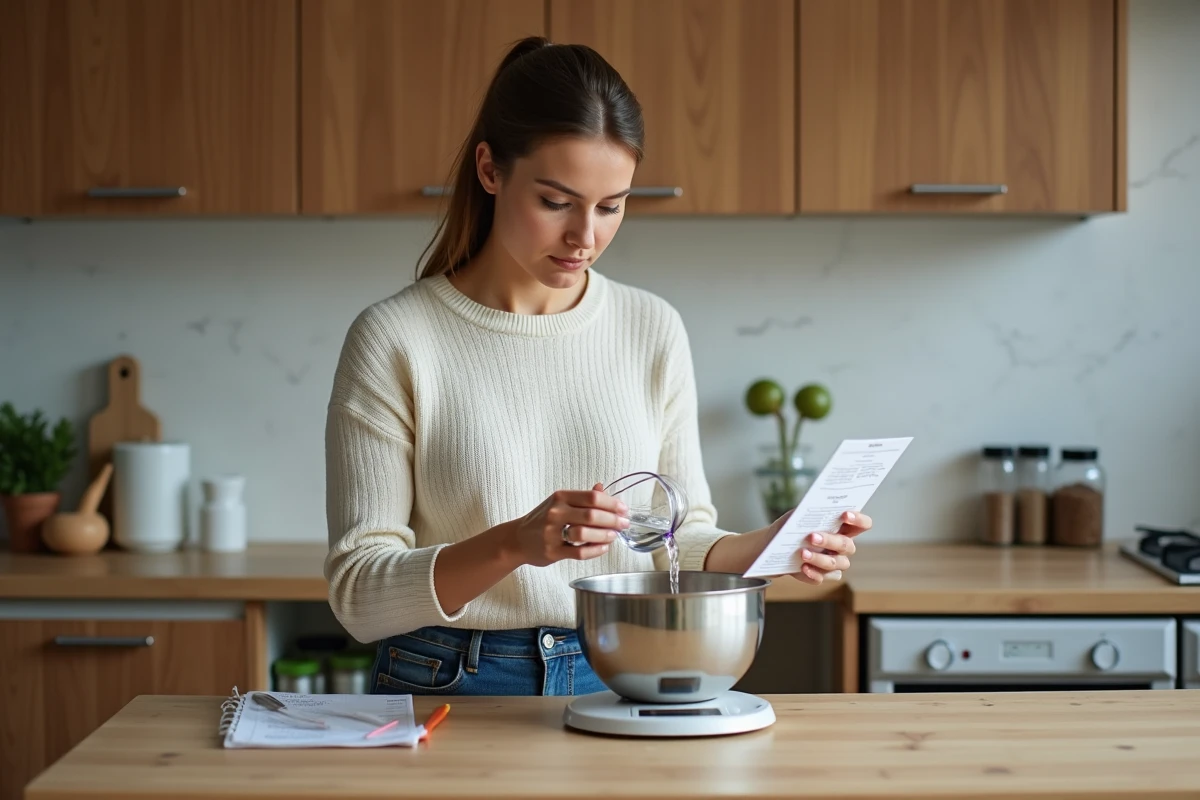
Obtaining 300 g of flour does not correspond to the same quantity in milliliters as 300 g of honey. The equivalence between grams and milliliters varies according to the density of each ingredient, which skews the automatic calculations often used. Confusing these measurements leads to discrepancies in texture or taste in culinary preparations. Solutions exist to avoid these errors: they rely on precise conversion methods and tools suited to each product.
Why 300 g does not always equal 300 ml in cooking
In cooking, grams and milliliters do not substitute for each other as easily as one might think. Weighing 300 g of sugar is not the same as filling a glass with 300 ml of milk: the difference lies entirely in density. Light flour, thick honey, fluid oil, each imposes its own volume law. Mistakes in conversion risk a failed dough or a disappointing cake, far from a trivial detail.
Mass quantifies the true amount, while volume pertains to the space occupied. Their link? The famous density, or mass per unit volume. For water, the equation is simple: 1 g = 1 ml. But as soon as we tackle flour (about 570 ml for 300 g) or honey (215 ml for the same weight), the landscape changes. That’s why any conversion from grams to milliliters requires more than a quick glance.
To avoid approximation, referring to a reliable resource simplifies everything: the page equivalence 300g in ml for cooking details the steps to follow. It highlights a simple formula: volume = mass ÷ density. No abstract calculations here: this principle guarantees accurate results, whether you are measuring sugar or olive oil.
How to adjust your conversions according to the density of each ingredient
It is impossible to convert 300 g into milliliters without paying attention to the density of the ingredient. The basis of reasoning remains the same: divide the weight, expressed in grams, by the density in g/ml to obtain the actual volume. There is no one-size-fits-all recipe; each product requires its dedicated conversion.
Some concrete examples for better visualization: flour has a density of about 0.53 g/ml, which places 300 g at 566 ml. With honey, dense at 1.4 g/ml, we get 215 ml for the same mass. Oil hovers around 0.9 g/ml, while milk is close to 1.03 g/ml. These nuances necessitate a rigorous approach.
To move from principle to daily practice, certain tools are indispensable in the kitchen: a scale allows for precise weighing, while a measuring cup translates the volume. For small measurements, tablespoons and teaspoons remain reliable allies.
Some precautions to adopt for each conversion:
- Always identify the specific density of the ingredient you are working with.
- Apply the formula volume = mass ÷ density seriously, without neglecting the step.
- Prefer reliable utensils, such as an electronic scale or graduated cup, to secure your measurements.
Paying attention to these conversions ensures the right balance of flavors and textures. Mastering the density of foods adds precision to your cooking and allows you to leave nothing to chance.

Practical charts and reliable tools to succeed in all your recipes
Given the variety of ingredients, conversion charts become valuable companions. To convert 300 g into ml, it is impossible to limit oneself to a single figure: one must consult the right references. Databases like Ciqual or USDA provide precise density values to rely on, whether preparing a cake batter or a homemade sauce.
| Ingredient | 300 g equivalent to (in ml) |
|---|---|
| Water | 300 |
| Milk | 291 |
| Flour | 566 |
| Honey | 215 |
| Oil | 333 |
Equipping yourself with a kitchen scale for weighing and a measuring cup for volume eliminates imprecision when pouring or adding. As for the charts, true cheat sheets, they allow you to anticipate consistency and faithfully reproduce each recipe, even if taken from an old notebook or adapted from a foreign bakery. The subtlety of measurement is the secret to dishes that deliver on their promises.