
Before renting a van to move your sofa, the central question is not whether the overall volume is sufficient, but whether the actual interior dimensions of the vehicle match those of your furniture. A standard three-seater sofa and a 6 m³ van have similar dimensions on paper. However, the differences often come down to a few centimeters, usually at the wheel arches or the ceiling height.
Usable volume and theoretical volume of a 6 m³ van: the gap that blocks
The technical specifications from manufacturers state a total loading volume. This figure includes all the interior space, including inaccessible areas: protruding wheel arches, forward-leaning partitions, unusable side recesses.
Since the updates for the 2023-2024 range, several manufacturers now publish the exact width between wheel arches, distinct from the maximum interior width. This measurement determines whether a sofa with wide armrests can fit or not. It can be found in the technical documentation for the Peugeot Expert, Citroën Jumpy, and Toyota Proace.
In practice, knowing the dimensions of a 6m³ van allows you to directly compare the usable length of the floor, the height of the rear door, and the width between arches with the measurements of your sofa.
| Interior dimension | Announced value (total) | Usable real value |
|---|---|---|
| Loading length | Close to 2.50 m | Reduced if partition is slanted |
| Interior width | Variable by model | Less than at the wheel arches |
| Usable height | Announced up to the roof | Limited by the height of the rear door |
The “usable real value” column explains why a sofa with seemingly compatible dimensions can still get stuck at the entrance of the van.
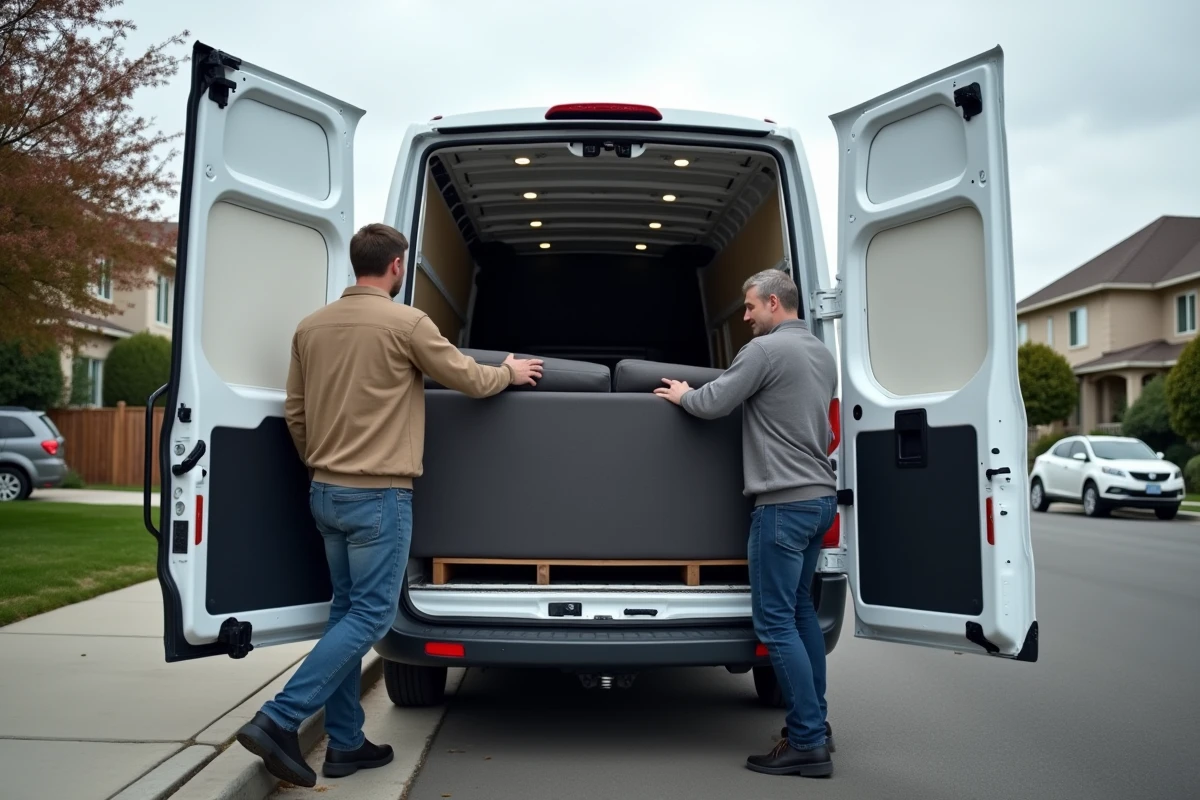
Measuring a sofa for transport in a van: the three dimensions to note
A sofa is not a rectangular prism. The armrests, the slanted backrest, and the legs alter the actual bulk compared to the dimensions displayed by the manufacturer.
Length, depth, height: where to measure
The length is measured from one armrest to the other, at the widest point. The depth is measured from the front edge of the seat to the furthest point of the backrest. The height goes from the floor to the top of the backrest, including the legs.
- Remove removable cushions and unscrewable legs before measuring: this reduces the height and sometimes the depth by several centimeters
- Measure the sofa standing (on its side) if you plan to load it vertically, as the depth then becomes the “height” to compare with the rear door opening
- For a corner sofa, measure each module separately if the sofa is disassemblable, or the total bulk of the L-shape if it is not
Comparing the sofa dimensions to the van
The comparison is done in three steps. First, check that the largest dimension of the sofa (often the length) is less than the usable length of the floor. Next, compare the depth or height (depending on the chosen orientation) with the width between wheel arches, not the maximum interior width.
The final check concerns the rear door. A sofa may fit in the van but not pass through the opening. The height and width of the rear opening are often less than the interior dimensions of the compartment.
Orientation and loading of the sofa in a 6 m³ van
Sliding a sofa flat into a 6 m³ van is rarely the best option. Placed on the seat, it occupies the entire width and blocks the rest of the load. Two alternatives yield better results.
Loading the sofa on its side (in a vertical position) reduces the footprint and frees up space for boxes or other furniture. The depth of the seat then becomes the height occupied, which generally fits under the van’s ceiling.
The other approach is to tilt the sofa diagonally, backrest towards the partition. This position works for two-seater sofas whose length slightly exceeds the interior width of the vehicle.
Straps and protection: avoid damage to the vehicle
Several rental platforms remind users that in case of damage to the cabin caused by a poorly secured sofa (tearing of the interior sheet metal, impact on the walls), a deductible or specific penalty may be applied even if the furniture fits within the volume. Getaround, in its updated advice page in 2024, explicitly mentions this risk.
- Wrap the armrests and corners of the sofa with blankets or bubble wrap before loading
- Use at least two ratchet straps attached to the van’s tie-down rings to secure the sofa
- Fill the free space between the sofa and the walls with rolled blankets or rigid boxes
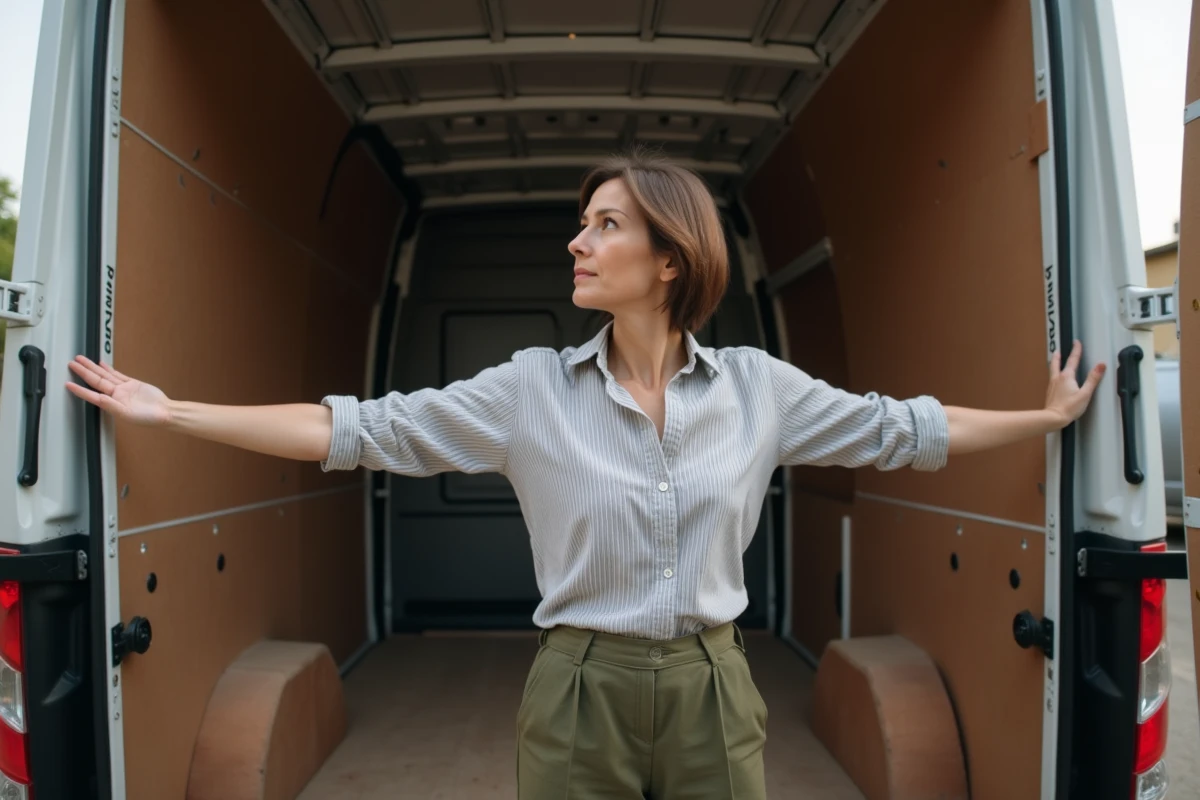
Corner sofa and convertible sofa: special cases in 6 m³
A monobloc corner sofa almost always exceeds the capacity of a 6 m³ van. Its L-shape creates bulk in two simultaneous axes that cannot be resolved by a simple change of orientation.
On the other hand, a disassemblable corner sofa into independent modules changes the game. Each section, measured separately, can fit into the van if the unit dimensions remain compatible.
The convertible sofa poses a weight issue more than a volume one. The sleeping mechanism (slats, metal frame) adds weight to the furniture and complicates handling in a confined space. Check the vehicle’s payload, not just the volume.
The determining factor remains the same in all cases: the width between wheel arches compared to the depth of the sofa. If this measurement does not fit, the overall volume of the van will not change anything.