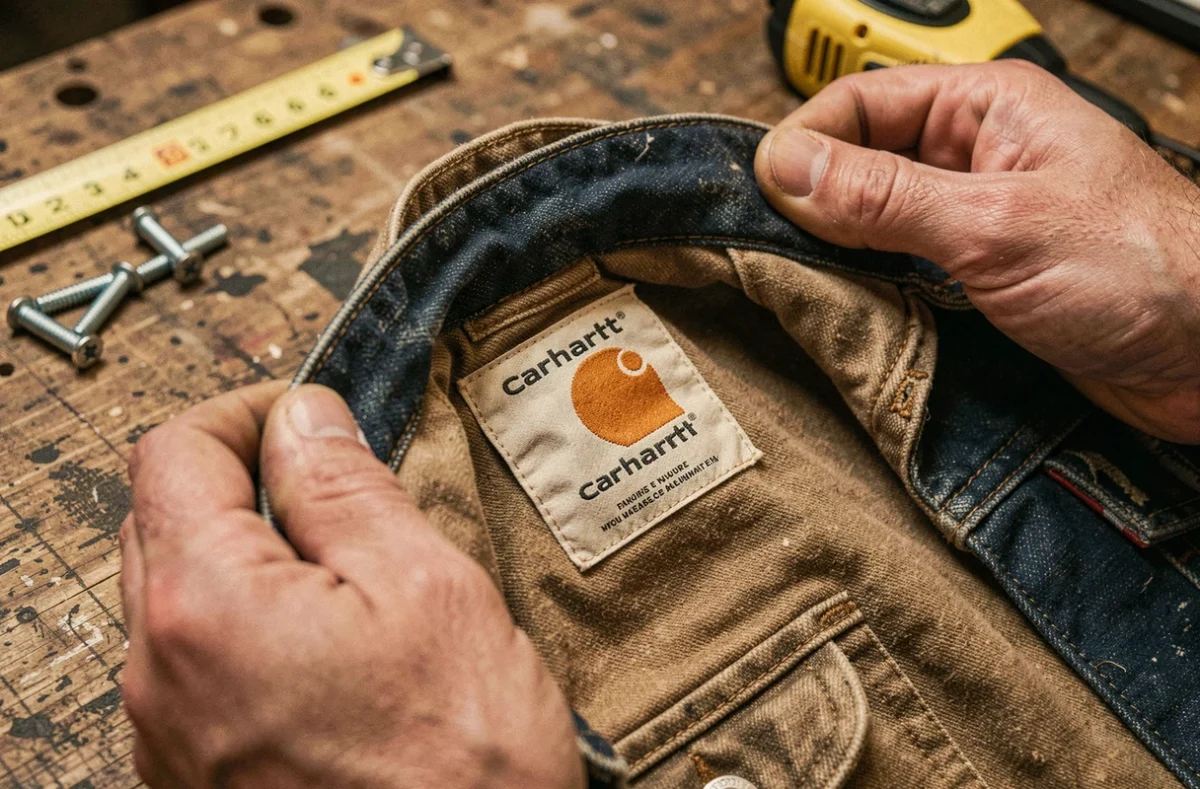
Authenticating a Carhartt garment is about more than spotting a spelling mistake on a label. Founded in Detroit in 1889, the brand has gone through decades of production, with variations in labels, manufacturing locations and finishes that make authentication more challenging. Mistaking a legitimate vintage piece for a counterfeit—or approving a fake because its label looks convincing—remains a real risk in the resale market.
Authentic Carhartt label vs. counterfeit: measurable differences
The label is the first thing people inspect, but it is also the most frequently misinterpreted. A checklist helps structure the verification process.
| Criterion | Authentic item | Common counterfeit |
|---|---|---|
| RN number | 14806 (consistent across Carhartt items) | Missing, altered or replaced with a made-up code |
| Style number | Present and matches the model (can be checked on the official website) | Missing or inconsistent with the advertised model |
| Spelling | No errors in the brand name, sizes or care instructions | Frequent mistakes (“middle” instead of “medium”; Carhartt name missing from the care label) |
| Label stitching | Even, with no stitching extending beyond the patch | Uneven, with loose threads or misaligned stitching |
| Country of origin | USA, Mexico, India or China, depending on the model and period | Sometimes missing; sometimes a country inconsistent with the model |
The RN 14806 number is a reliable reference, but it should be cross-checked against the style number. A correct RN number on a label whose style number does not match any documented model is a red flag. To tell a real Carhartt from a fake, this two-part check remains the quickest method.
Fabric, zipper and stitching: what the label doesn’t tell you
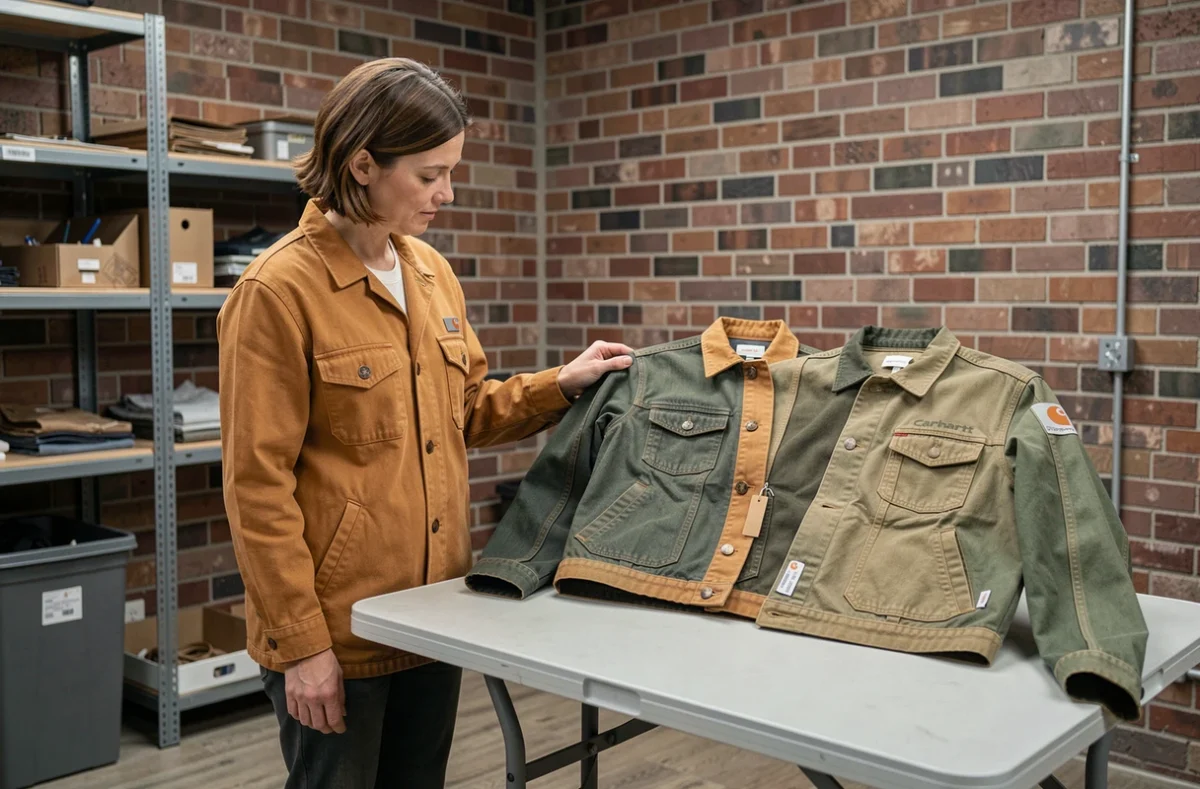
A counterfeit can reproduce a label convincingly. Fabric and finishing are harder to imitate.
The cotton duck canvas used by Carhartt feels dense and stiff when new, then softens over time. Counterfeits often use thinner fabric, sometimes with a sheen, that lacks the weight and texture of the original canvas. On a Detroit jacket or Chore Coat, the difference is noticeable when you pinch the fabric between two fingers.
The zipper is an often-overlooked indicator. Authentic items feature sturdy zippers, often branded. Counterfeits use lightweight plastic or unbranded zippers, which may stick from the very first use.
- The chest patch should be stitched evenly, with no loose threads and clean edges. A glued or poorly centered patch is a telltale sign of a counterfeit
- The inner seams of an authentic jacket are double- or triple-stitched at stress points (shoulders, armholes). Fakes often use a single row of stitching
- A molded plastic Carhartt logo attached to the fabric, instead of an embroidered or woven patch, is a recurring warning sign on counterfeits
Vintage Carhartt items and unusual labels: don’t mistake old for fake
This is the most common pitfall on resale platforms. An item from the 1990s or early 2000s may have a label that looks very different from current standards without being counterfeit.
Collectors report that some early Carhartt WIP items used labels from the main line. WIP-specific labels were introduced gradually, creating a gray area. An unusual label on an older item is therefore not enough to prove it is counterfeit: it must be assessed alongside the model, its production period and the garment’s construction.
The “Made in USA” label is not a reliable way to date an item either. Carhartt still makes clothing in the United States, contrary to the common belief that this label guarantees an older piece. Cross-checking the country of origin with the style number and fabric type gives a more reliable estimate.
What to do if the label is missing or illegible
On a well-worn vintage item, the label may have been unstitched, faded or cut off. In that case, authentication depends entirely on the physical details.
- Examine the canvas quality and lining type (flannel, Sherpa or quilted, depending on the model and era)
- Check the pocket shape, chest patch placement and type of snap buttons or zipper
- Compare the item with photos of documented models in collector archives or specialist forums
- Ask the seller for clear photos of the garment’s interior, seams and any remaining markings
Where you buy and warning signs on resale platforms
Authentication doesn’t stop with the garment itself. The sales context can also provide useful clues.
Offers for new items sold in bulk at heavily discounted prices are a warning sign distinct from the secondhand market. A guide published by Carhartt Rework (an independent studio unaffiliated with the brand) distinguishes secondhand sales from these heavily discounted new lots. This is not automatic proof of counterfeiting, but it does warrant checking the seller’s identity, invoice and photos of the items on offer.
On resale platforms, sellers and buyers report that listings for suspicious items are not always taken down after being reported. Keeping screenshots of the listing and messages with the seller is still the best protection in case of a dispute. Asking for additional photos of the labels and details before buying reduces the risk of receiving a counterfeit with no recourse.
An unusually low price for an item advertised as new, a seller whose catalog mixes unrelated brands, or a listing with no photos of the labels: taken together, these are good reasons to walk away. Authenticating a Carhartt item means looking for multiple checks that support one another, not relying on a single criterion.