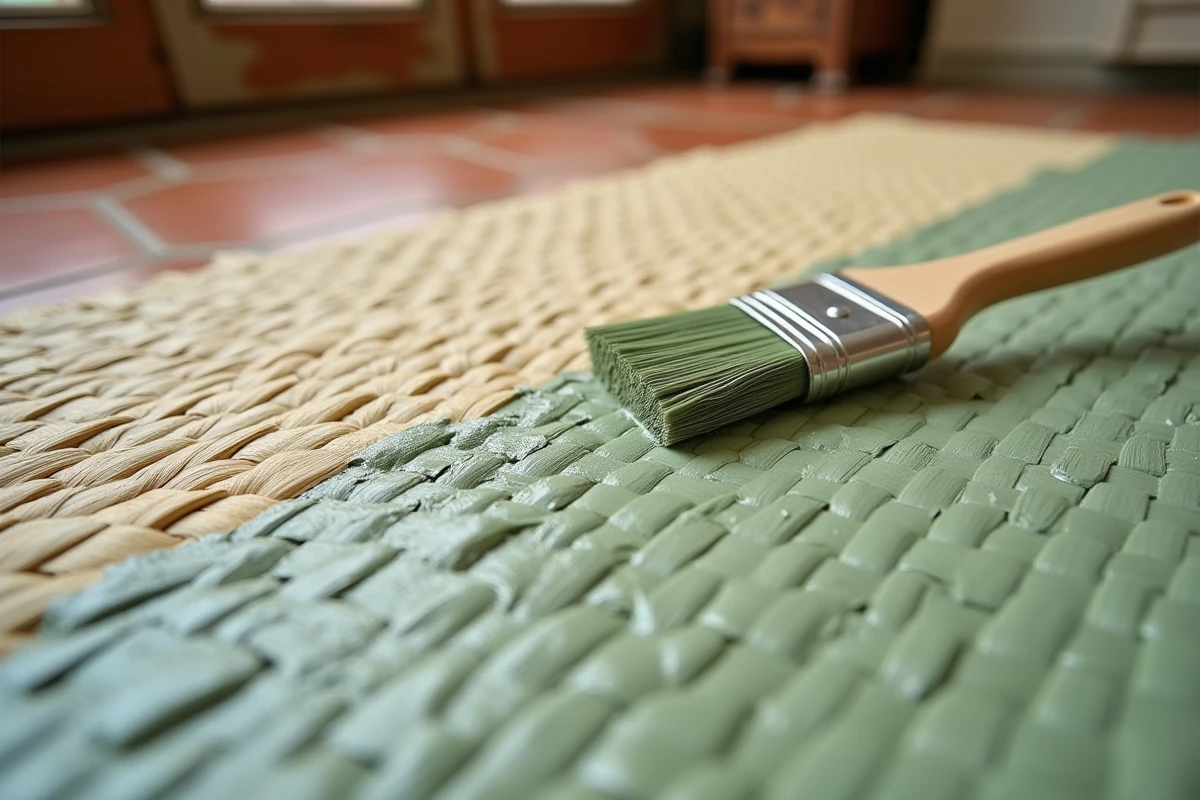
Sea rush accepts paint, but not just any paint or under any conditions. Its plant fiber, naturally rich in silica, reacts differently than sisal or coconut when faced with colored coatings. Here, we detail the technical points that make the difference between a durable result and a coating that peels off within months.
Painting sea rush in a humid bathroom: adapting the protocol to humidity
Sea rush installed in a humid room continuously absorbs ambient water vapor. This permanent hygroscopicity prevents standard paints (classic acrylics, budget vinyls) from forming a stable film. The binder dries on the surface, but the fiber remains saturated underneath, causing flaking after a few weeks.
We recommend an acrylic paint formulated for porous substrates in humid environments, with a binder content higher than that of common decorative ranges. The label should mention a resistance to residual humidity of the substrate. Floor paints rated for wet areas are suitable, provided the manufacturer’s recommended dilution is followed.
Ventilation of the bathroom during and after application changes everything. Without mechanical extraction (VMC or continuously open window), the drying time between coats is significantly extended, and the risk of blistering increases. Before painting, we place a dehumidifier in the room for several days to lower the residual humidity of the rush. If you are looking for tips for painting sea rush suitable for this type of constraint, the choice of primer will be crucial.
Adhesion primer on plant fiber: a step that should not be overlooked
Applying paint directly on sea rush without a primer is the primary cause of failure. The natural fiber absorbs the binder of the paint, leaving a poorly fixed pigment on the surface that crumbles away.
An adhesion primer for porous plant substrates creates an interface between the fiber and the finishing coat. We prefer water-based primers formulated for raw wood or natural fibers, which penetrate the braid without excessively stiffening it.
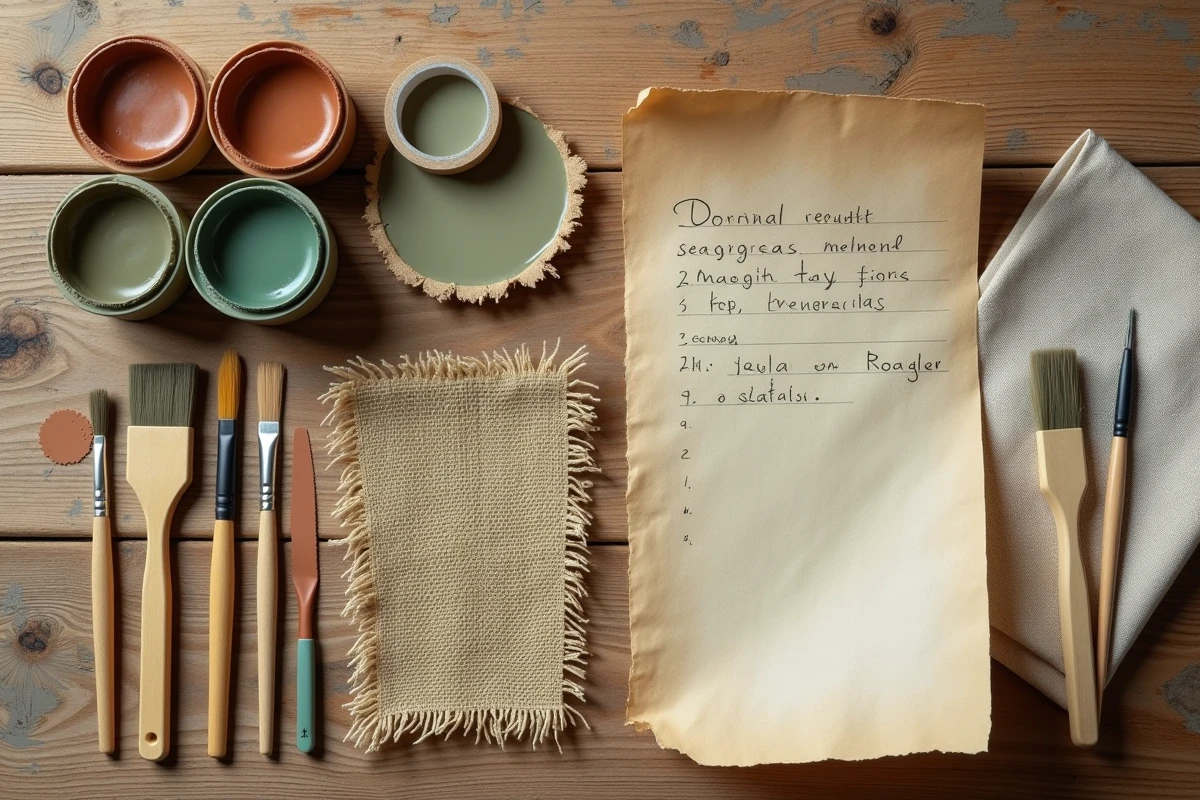
Application is done with a long-haired roller (minimum 15 mm) to reach the crevices of the braids. A lacquer roller or foam roller only deposits the product on the tops of the fiber, creating partial adhesion. Two crossed passes ensure even coverage.
Drying time of the primer before painting
The time between primer and first coat of paint directly depends on the ambient humidity. In a dry and ventilated room, the drying time recommended by most manufacturers is sufficient. In a bathroom or semi-buried room, we systematically double this time. A primer that is still tacky to the touch is not dry underneath, even if it appears matte on the surface.
Choosing floor paint for sea rush: diluted acrylic or polyurethane resin
Sea rush handles diluted acrylic paints better than sisal, thanks to its natural silica content that limits film cracking during drying. This property allows the use of water-based paints rather than solvent-based resins, with comparable results in terms of durability.
Two families of products work on this coating:
- Acrylic floor paints, diluted between 5 and 10% with water for the first coat to promote penetration into the fiber, then applied pure as a finishing coat.
- Water-based polyurethane resins, which offer superior abrasion resistance but stiffen the surface of the rush, altering its texture to the touch.
- Colored stains for natural fibers, less opaque but preserving the visible braided appearance, suitable for decorative use in low-traffic areas.
The choice depends on the usage. A bedroom handles a standard acrylic floor paint very well. A hallway or entryway requires the additional durability of a polyurethane resin. In a bathroom, only a formulation resistant to permanent humidity provides a lasting result.
Preparing sea rush before painting: mistakes that ruin adhesion
A recently installed sea rush still contains residual moisture from the glue and substrate. Applying paint too soon increases the risk of discoloration and delamination. Wait at least four weeks of ambient drying after installation before any painting, according to feedback from craftsmen compiled by Batipedia.
Mechanical dusting precedes any application. A rotary brush vacuum removes particles embedded in the braids. A simple sweeping is not enough; residues trapped in the crevices of the fibers prevent the primer from penetrating evenly.
Cleaning before painting: water or degreasing product
If the sea rush has been in place for several months or years, a light cleaning with diluted black soap removes grease deposited by foot traffic. We emphasize thorough rinsing and complete drying before considering the primer. A soap residue creates a greasy film that repels the undercoat.
In case of localized stains (grease, wine, coffee), a spot treatment with Sommières clay before the overall cleaning prevents diluting the stain into the fiber during washing.
Applying paint on sea rush: roller, number of coats, and final finish
The long-haired roller remains the only suitable tool. A brush is suitable for borders and corners, but covering an entire surface with a brush takes an unreasonable amount of time and produces thickness irregularities.
We apply a minimum of two finishing coats, respecting the complete drying time between each pass. The first coat, slightly diluted, penetrates the fiber. The second, pure, ensures opacity and mechanical resistance of the finished coating.
A matte finish is the most natural on sea rush. Satin or glossy finishes accentuate the irregularities of the braid and give a plasticky appearance that is not flattering. If the room needs brightness, we prefer to lighten the shade rather than increase the gloss.
A properly painted sea rush maintains its braided appearance, gains in personalization, and remains washable on the surface. The fiber still breathes under the film, provided that each step (drying, primer, dilution, ventilation) has been respected in order.