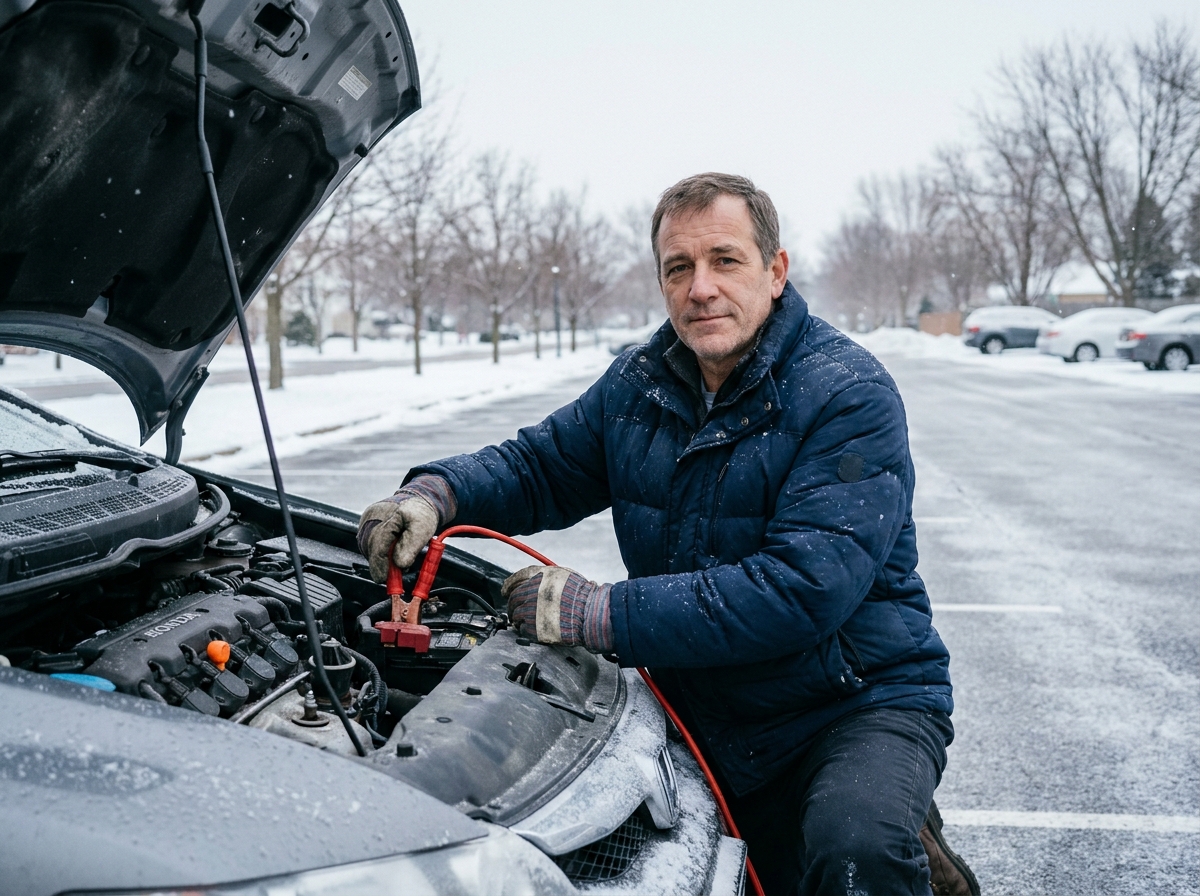
The battery remains the primary cause of car breakdowns in winter. Understanding what happens inside a battery when temperatures drop allows us to focus on the actions that really matter, rather than applying a list of generic tips.
Battery capacity according to temperature: measured differences
A battery does not lose its charge linearly with the cold. The drop in capacity accelerates as soon as the thermometer goes below zero, because the internal electrochemical reactions slow down and internal resistance increases.
| Outside temperature | Starting consequence |
|---|---|
| +20 °C | Normal start, nominal capacity |
| 0 °C | Slight power loss, often imperceptible |
| -10 °C | Slower starter, especially on diesel engines |
| -20 °C | High risk of no start if the battery is over 3 years old |
These orders of magnitude show that a battery in good condition can easily withstand a moderate frost episode. The problem arises when a battery that is already weakened encounters the cold: the safety margin disappears.
At the same time, the engine itself requires more energy to start in cold weather. The engine oil thickens, the starter works harder for longer, and electrical consumers (heating, defrosting, headlights on from the morning) draw on the battery even before the alternator takes over.
When subscribing to a motorcycle or car insurance, winter battery failure is among the most common assistance claims, confirming the extent of the phenomenon across all types of vehicles.
Summer degradation and winter breakdown: the unknown gap
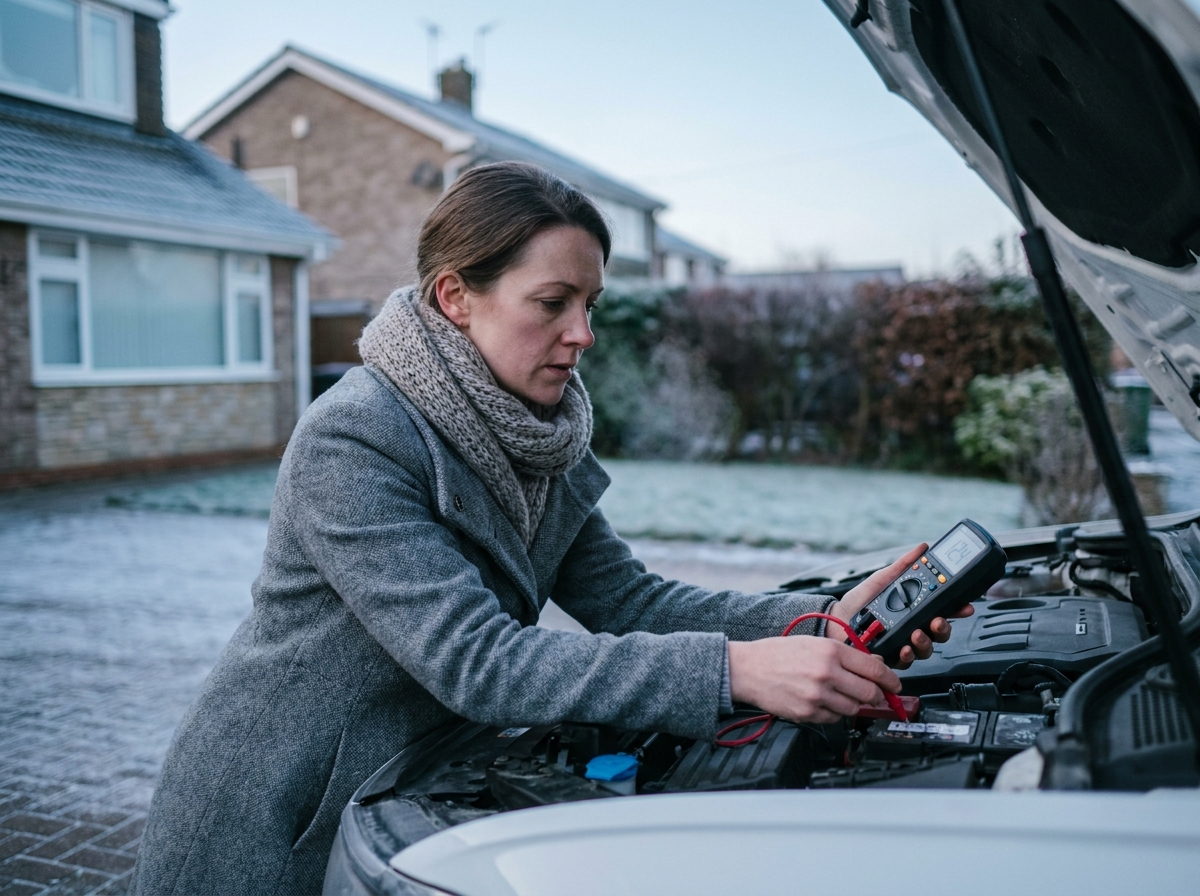
Common content describes the cold as the enemy of the battery. The reality is more nuanced: the battery ages in summer and fails in winter. High temperatures accelerate the internal corrosion of the lead plates and promote electrolyte evaporation. A battery that has endured a heatwave summer arrives in October with already reduced capacity, without the driver noticing.
The first cold morning acts as a revealer. The remaining capacity, sufficient at 15 °C, no longer meets the starting needs at -5 °C. This is why breakdowns concentrate on the first cold waves of autumn, not necessarily in the heart of winter.
Signs of a battery weakened by heat
- The starter turns a bit slower than in spring, even in mild weather (a sign of lower resting voltage).
- The headlights dim slightly at idle, with the engine running, indicating that the alternator is already compensating for a battery that can no longer hold its charge.
- The vehicle has spent the summer parked in full sun for several weeks without running, promoting self-discharge and plate sulfation.
A battery test at a garage or with a portable load tester in September can detect these weaknesses before they turn into a breakdown on a November morning.
Concrete prevention actions before and during winter
Not all advice carries the same weight. Parking your vehicle in a garage, for example, keeps the battery a few degrees above the outside temperature, preserving a significant portion of its capacity. In contrast, covering the battery with insulating fabric without a garage around produces only a marginal effect.
High-impact actions on battery lifespan in winter
- Favor sufficiently long trips so that the alternator can properly recharge the battery. Repeated short trips (less than 10 minutes) gradually discharge it without giving it time to recover.
- Turn off seat heating, rear defrosting, and ventilation before turning off the ignition, so that the last charging cycle of the alternator benefits the battery and not the accessories.
- Use a maintainer charger (or smart charger) if the vehicle is parked for more than a week. These devices compensate for natural self-discharge and prevent sulfation.
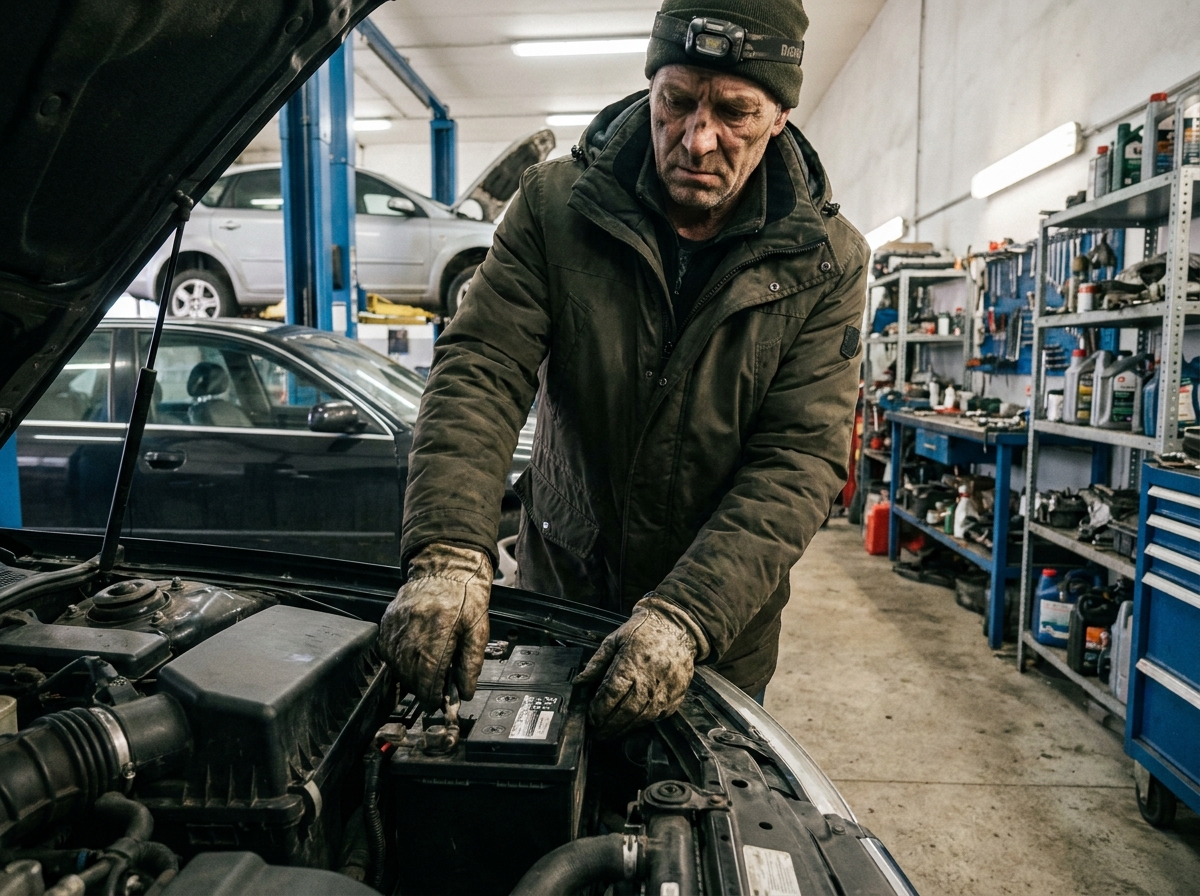
- Check the battery terminals: oxidation creates resistance that reduces the current transmitted to the starter. Cleaning with a wire brush and a bit of dielectric grease eliminates this problem for the entire season.
What changes for electric vehicle batteries
The cold also affects the lithium-ion batteries of electric vehicles, but differently. The thermal management system (BMS) heats the cells to maintain their operating range, which consumes energy and reduces real range in cold weather. In some models, the winter range loss can reach a quarter to a third of the range displayed in temperate conditions.
The Regulation (EU) 2023/1542 on batteries, applicable from February 2024, now imposes performance, durability, and labeling obligations on all batteries placed on the European market. In the long term, this regulation should improve the quality of 12 V starter batteries as well as traction batteries, with a direct impact on their cold performance.
Jump leads and portable booster: last resorts, instructions
When the battery has failed despite precautions, two options exist: jump leads connected to another vehicle, or a portable booster (compact lithium battery).
With jump leads, the order of connection matters. The red cable connects first to the positive terminal of the flat battery, then to the positive terminal of the donor battery. The black cable connects to the negative terminal of the donor battery, then a metal ground of the broken-down vehicle (engine block, ground point), never to the negative terminal of the discharged battery. This precaution limits the risk of sparks near the battery, where hydrogen gas may accumulate.
A portable booster makes the operation simpler and safer, but its own lithium battery also loses efficiency in extreme cold. Keeping it inside the home (not in the trunk) and recharging it regularly ensures it will be operational when needed.
A load test at the start of autumn and sufficiently long trips to properly recharge the battery eliminate the vast majority of these breakdowns, without any special investment.